Blog
How a Busy Screen Wins Over AI Judges
Do AI judges follow the same distribution as human preference?
How RL Improved Kimi K3.1 Pro’s Games
Kimi K3.1 Pro is the #1 open-weights model on DesignArena’s Game Dev leaderboard, taking the title from its predecessor, Kimi K3. It also ranks #6 among all models, against K3’s #10.
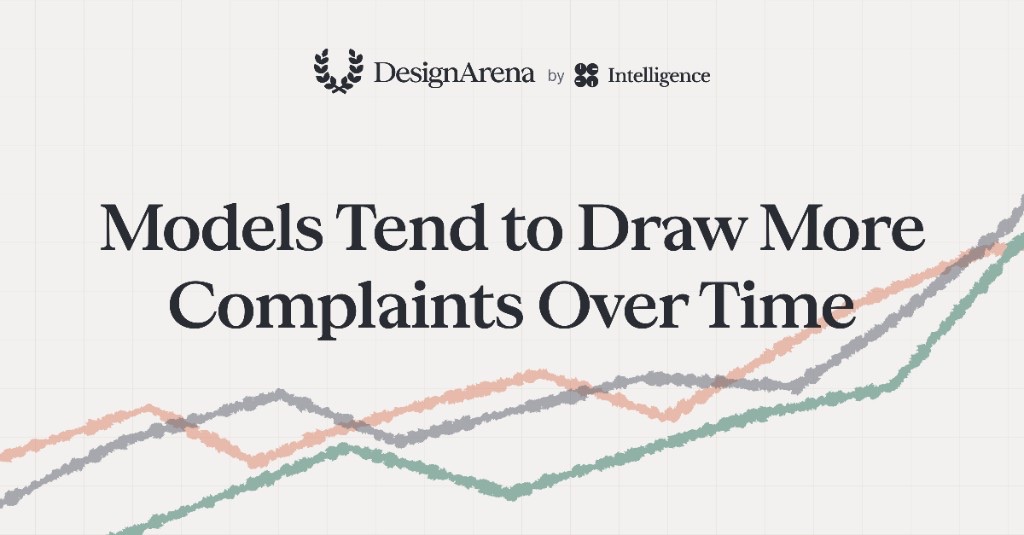
AI models tend to draw more complaints the longer they’re out
Does the same model draw more complaints as the months go by?

How Thinking Can Hurt One-Shot Websites and Games
Does a model build better websites and games when it thinks longer? We compared the two highest reasoning effort levels of Muse Spark 1.3 from Meta, Xhigh and Max, on prompts that both settings answered on DesignArena. In a sample of about 800 website and game prompts, Max thought about a third longer than Xhigh on the websites and nearly twice as long on the games.
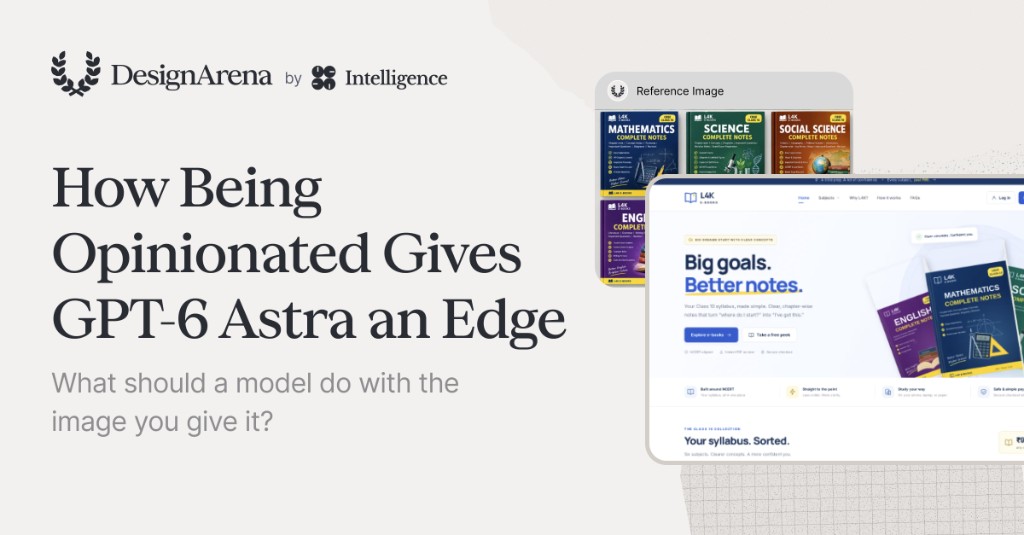
How Being Opinionated Gives GPT-6 Astra an Edge
What should a model do with the image you give it? On DesignArena, users can attach a reference image when they ask for a website. Most models treat that image as a blueprint and reuse its colours, its layout, and sometimes the image itself.
When does taste become slop?
Has beige serif become the new purple gradient? We analyzed tens of thousands of websites generated with DesignArena from January through October 2026, and we were surprised to find that some familiar styles have gained favor since the start of the year while others have lost it. To get there, we used the same head-to-head votes behind our model leaderboards, but looked at which styles of website won rather than which models did.
Audio Realism Benchmark: Measuring Realism in Audio Models
Today we’re introducing Audio Realism Bench, our benchmark for AI conversational realism. Modern TTS has saturated the traditional 1–5 mean opinion score (MOS) and while it is able to capture intelligibility and naturalness, it no longer meaningfully separates frontier systems that all produce clean speech. Audio Realism Bench instead evaluates realism as an emerging signal for high quality audio generations. Given two recordings of the same transcript, (presented blindly and in randomized ord
Kimi K3’s Design Secret may be in its Thinking Traces
Kimi K3, Moonshot AI’s latest open-weight1 model, ranks 1st on our single-shot Frontend Arena with an Elo of 1392. This is 10 positions higher than Kimi K2.6 and 16 positions higher than Kimi K2.7 Code, marking the largest jump we’ve seen in the Moonshot model line. However, we found that Kimi K3 uses an extreme amount of thinking tokens, using over 12x more reasoning than Claude Opus 4.8 and over double that of Kimi K2.6. This is a lot of reasoning, and we decided to dig deeper to find out ex
Thinking Machines’ Open Weights Model is Now on Design Arena
We are excited to introduce Inkling, Thinking Machines' first model - and it’s open weights. With this release, Thinking Machines establishes itself as a top 6 lab in agentic workloads. Inkling is the top US-based open weights model, representing a step forward for the open source ecosystem as a whole. 0:00 /0:14 1× Where it Ranks Inkling ranks #9 on our agentic Web Apps leaderboard, just behind Qwen 3.7 Max and at the same tier as Claude Opus 4.6 an
How OpenAI’s Sol Finally Learned Design Taste
We benchmarked GPT-5.6 Sol on Design Arena’s Web Design (Non-Agentic) Arena, and we were surprised to find that it ranks 1st overall. This is 18 places higher than its predecessor GPT-5.5, and is the first time an OpenAI model has placed first on this leaderboard. We dug deeper and broke down the deployments of GPT-5.6 Sol to track which frontend coding tasks the model excels at: 1. GPT-5.6 Sol appears to recognize and actively suppress common AI design anti-patterns. We projected the CLIP emb

What we've learned from 50,000+ AI slides generations… open sourced for you today
We've seen a massive uptick in demand for AI-generated slides at DesignArena - it’s become one of our fastest-growing creation categories. The harness-level implementation of slides is nuanced and often overlooked. We’ve generated over 50K slides now and have experimented with every harness possibility… long story short: the perfect Slides generation pipeline doesn’t exist. So we built it… and open-sourced it for you today :) Here are the field notes for everything we learned along the way.
Gemini Omni Flash: A Video Model for Directors
We benchmarked Gemini Omni Flash on Video Generation, and it took first place by 102 Elo points. Gemini Omni Flash ranks 1st overall on Design Arena’s Video Arena evaluation, 7 places higher than its highest-performing predecessor Veo 3 Fast. To do so, it surpassed the Seedance 2.0 model line, which has held the top spots on our leaderboard since its launch in February. Gemini Omni Flash also sets a new Pareto frontier for preference vs price at approximately ~$0.10 per second of video compared

How GLM-5.2 Beat Fable 5 at Website Design
GLM 5.2 ranks 1st overall on Design Arena’s single-turn, HTML Web Design (Non-Agentic) evaluation, 5 places higher than its predecessor GLM-5.1. To do so, it beat Claude Fable 5, Opus 4.6, and Opus 4.7, a model line that has held the top spots for months on our leaderboards and won more head-to-head matchups than any other model we track. This is the first model to do so, and it’s MIT licensed. Especially impressive is that Z.ai has achieved this result with a model that is the same size as GLM-
Opus 4.8’s Hyperfocus on Agents is Making It Worse at Design
We benchmarked Opus 4.8 on single-turn Web Dev, and we found something rather surprising… it performs significantly worse compared to Opus 4.7, and all other Anthropic models for that matter. Rather shockingly, Claude Opus 4.8 ranks 23rd overall on Design Arena’s Web Dev (Non-Agentic) evaluation, which is 20 placements lower than its predecessor Opus 4.7 and 22 places lower than the newly released Fable 5. This marks a notable regression from Fable (1st), Opus 4.6 (2nd) and Opus 4.7 (3rd), a mo
Reve 2.0 establishes Reve as the top independent foundation image model lab
We are excited to introduce Reve 2.0 – Reve’s most capable image generation model to date. With this release, Reve becomes the highest-ranked independent foundation image model lab on Design Arena. Utilizing a new layout architecture, Reve 2.0 advances the field of AI-powered creativity with native 4K rendering, layouts that allow for easy editing, strong spatial reasoning, and remarkable compute efficiency, letting users act as creative directors. Where it Ranks Reve 2.0 is the 2nd leading

Ideogram 4.0 Is Now the Frontier Open Image Model For Design
Data updated on June 8th, 2026. We are excited to announce that Ideogram 4.0, Ideogram’s most powerful image generation model to-date, is the frontier open-image model for image design. Designed with creative workflows in mind, Ideogram 4.0 brings a new level of capability to the frontier of AI-powered image design, with improved prompt adherence, stronger aesthetic judgment, and more consistent performance across a wide range of visual tasks. Where it Ranks Ideogram 4.0 is the 5th leading

Evaluating Mobile App-Building Agents
As coding agents mature, evaluation has become a core bottleneck. Design Arena’s core goal is to find the edges of model capability by evaluating agents on real-world application building, not toy tasks. We’ve seen models steadily improving quality and reliability in our React/web arena. To keep pushing that frontier, we recently expanded beyond frontend-only apps into fullstack work with real backends and real databases (also see this post). Today we’re introducing Mobile Arena — another sharp

Fullstack Arena Methodology
Real-World Full-Stack Web Application Benchmarking This platform tests whether AI coding agents can autonomously build complete, production-grade full-stack web applications with real persistent databases. Each model receives a user prompt describing an application, and must independently design a database schema, seed it with realistic data, build Vercel serverless API routes, construct a React frontend that fetches from those routes, and deploy the finished application to Vercel. We are bench
Founding Launch Designer
What if you got to announce the moments that define a new era of intelligence? When Christopher broke Enigma, when Deep Blue beat Kasparov, when AlphaGo beat Lee Sedol—these weren't promotional moments. They were the world discovering what our machines could do, in large part because someone figured out how to show these stories. We're building Arcada, the world stage for AI. We create arenas: real products, scaled to millions of users, that measure what models can actually do in the real wo
Design Arena Methodology
Leaderboard Rankings emerge from collective community preferences rather than curated opinions. Each pairwise comparison is weighted equally. The Elo score is approximated through the Bradley-Terry model. The model estimates each model's inherent strength through an iterative algorithm that converges when strength estimates stabilize (threshold: 0.0001) or reaches 200 iterations. For each model, the algorithm updates its strength based on total wins divided by the sum of comparison probabilit
Agent Runner: A Standard, Open-Source Agent Harness for Evaluating Real-World Coding Agents
As LLM-based coding agents mature, evaluation has become a core bottleneck. Existing benchmarks largely rely on static tasks and capture only the model’s final output, not the intermediate reasoning steps or tool interactions that define modern agentic systems. To study these systems rigorously, we need instrumentation that reflects how agents are used and behave in actual development environments. AgentRunner is an open-source agent harness that executes real Design Arena user prompts, traces
How Microsoft Research Asia used Design Arena to validate their aesthetic coding benchmark
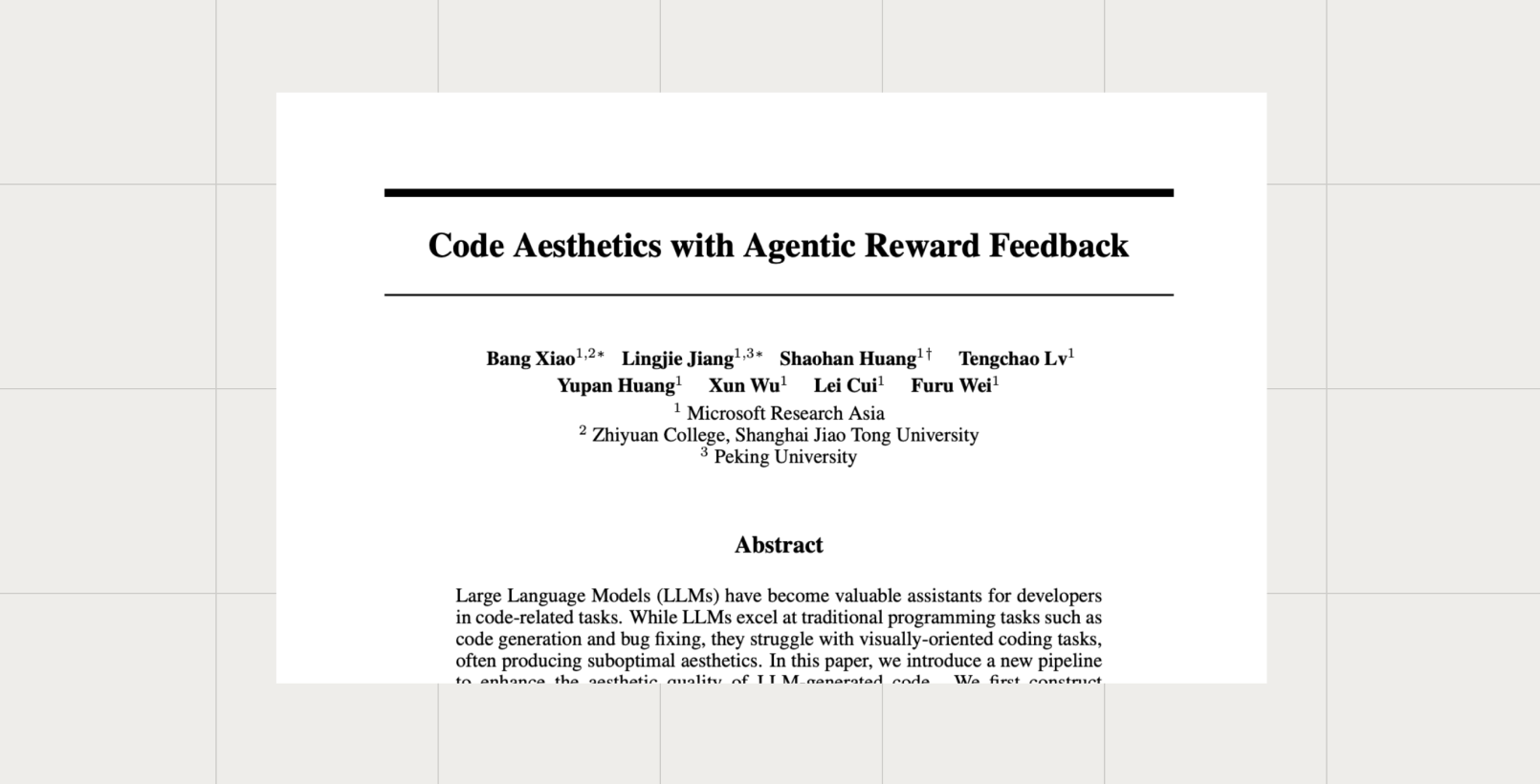
We recently added AesCoder-4B to Design Arena: a new model trained by a team from Microsoft Research Asia. AesCoder-4B is comparatively tiny at just 4 billion parameters, but as of the time of this writing, it is beating several flagship models in the Website rankings, including Gemini 2.5 Pro, DeepSeek R1, and Sonnet 4 (Thinking). AesCoder is also significantly faster than its peers, holding one of the highest Elo-to-generation-speed ratios in the Website category. According to the model’s co

Introducing Micro Evals
An overview of our live skills assessment methodology. What are Micro Evals? The current bottleneck in model progress isn’t figuring out how to improve models—it’s knowing what needs improvement. Creating realistic coding tasks for training or RL environments is difficult when you don’t know where models actually fail. Most data efforts rely on synthetic or reverse-engineered examples, which often produce inflated results on contrived codebases that bear little resemblance to real-world use.

In pursuit of a benchmark for human taste
We know when we like something, but when asked why, we stumble over our words and hallucinate reasoning. We contradict ourselves—we don’t know why we like a thing, we just do. There exist people who understand our preferences better than we do ourselves. Let’s call them Tastemakers. Tastemakers know what we really want, not just what we say we want. Not a faster horse; a car. Great taste is a marker of how well we are understood. Today’s frontier models still struggle to make the designs that
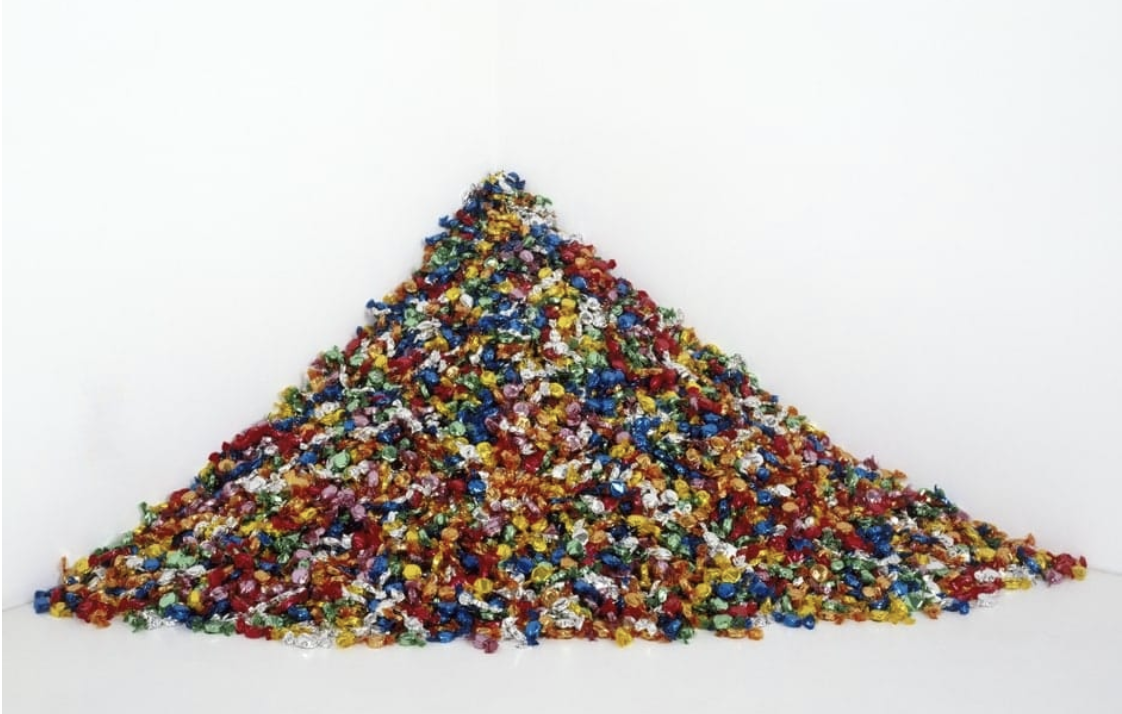
The prompt is not the picture
“When an artist uses a conceptual form of art, it means that all of the planning and decisions are made beforehand and the execution is a perfunctory affair. The idea becomes a machine that makes the art.” – Sol LeWitt, Paragraphs on Conceptual Art (1966)
